ATLAS
Commissioned as a sculpture for public space, Atlas was an attempt to have an excavator buried by itself.
According to Greek mythology, Atlas was punished for leading the Titans in their battle against Zeus. Zeus subsequently sentenced him to carry the heavens. Contrary to popular belief, the globe Atlas carries in his depiction is not the Earth but a representation of the night sky. Regardless of what he carries, Atlas is always interpreted as a symbol of strength and endurance. This is likely also the case for the company ATLAS, which manufactures excavators and other construction equipment.
The concept for ATLAS was developed at the invitation of the municipality of Nijmegen to create an artwork for an art route. This route was intended to highlight an area where the municipality planned to build a new district within a few years. Real estate sales were promoted by showcasing the landscape that would disappear precisely because of the sale of this property. From this contradiction arose the idea to reverse the role of project development and location, by sacrificing a machine to the landscape before it falls prey to other construction machines.
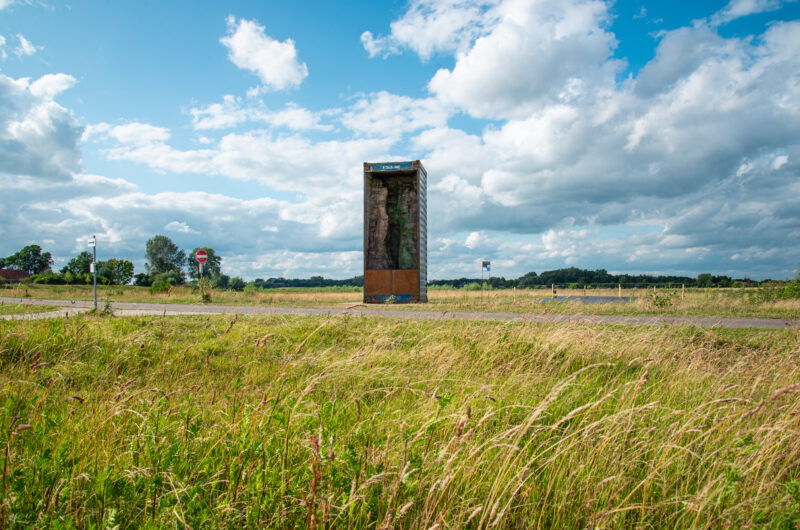
ATLAS is an attempt to have an excavator bury itself, after which its remains are incorporated as a sculpture in the art route. The purpose of this sculpture was to function as a kind of monument. On the one hand, to the action from which it originated, and on the other, to the tragic reality that development and decay always go hand in hand. The delivery of ATLAS requires transforming a powerful machine into a lost piece of steel.
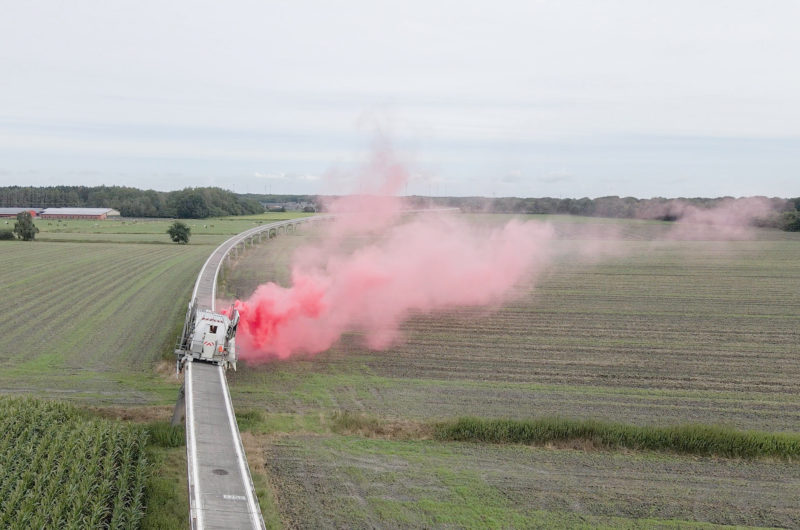
Ultimately, the burial never actually took place during the execution. After laboriously digging a suitable hole, a hydraulic line burst as the crane descended into it. With a bang, oil spewed from the machine and then fell defenselessly into its grave. The oil continued to flow from the crane like a kind of arterial bleeding. Although the performance didn’t go as planned, it did evoke empathy, emotions of disappointment, and sadness in the audience. The municipality’s bouquet of flowers was then distributed to all who collectively laid a flower at the crane. Afterwards, the excavator was covered by another machine. In 2020, ATLAS was removed to make way for construction.
Directed by Froukje van Wengerden
Camera, edit and grading: Lukas de Kort